
The last time I flew with Qatar Airways (“QR”) was before I started writing this blog, and the next time will be later in 2018. But in the meantime I want to share with you why QR has been my favourite airline for the past five years, giving you the pros and some cons:
Pros
Fleet – QR is a young airline which has expanded greatly in the past decade, to c.180 planes today. It therefor has a young fleet (average age just 5 years), comprised of all of the most modern aircraft types: the Boeing 787 Dreamliner (my personal favourite aircraft), the B777, the awesome Airbus A380 Superjumbo, the new Airbus A350 and narrow-bodied Airbus A320s. QR is the launch customer of the latest A350-1000, which is due to take to the skies in March 2018 and it was the launch customer for Airbus’ A320 new engine option (“Neo”) in 2016 but actually cancelled its order because the new engines didn’t perform to spec, which has given QR a reputation as a most demanding and precise buyer of aircraft and aircraft interiors (delivery of A380s and A350s was delayed to ensure cabin perfection).
Hard Product (Seat) – QR only offers First Class on its A380s; all other aircraft top out with Business Class at the pointy end. Any airline with a large fleet takes several years to apply seat and cabin updates across the whole fleet, and QR currently finds itself offering three very different Business Class products on its long haul operations, with all three operating out of London. Its Airbus A330s and most if its B777s fly with a conventional, but dated, 2-2-2 cabin layout in Business. All seats are fully (180 degrees) lie-flat, but window seat passengers have to climb over their neighbour to get to the aisle if the neighbour’s seat is in the bed position.
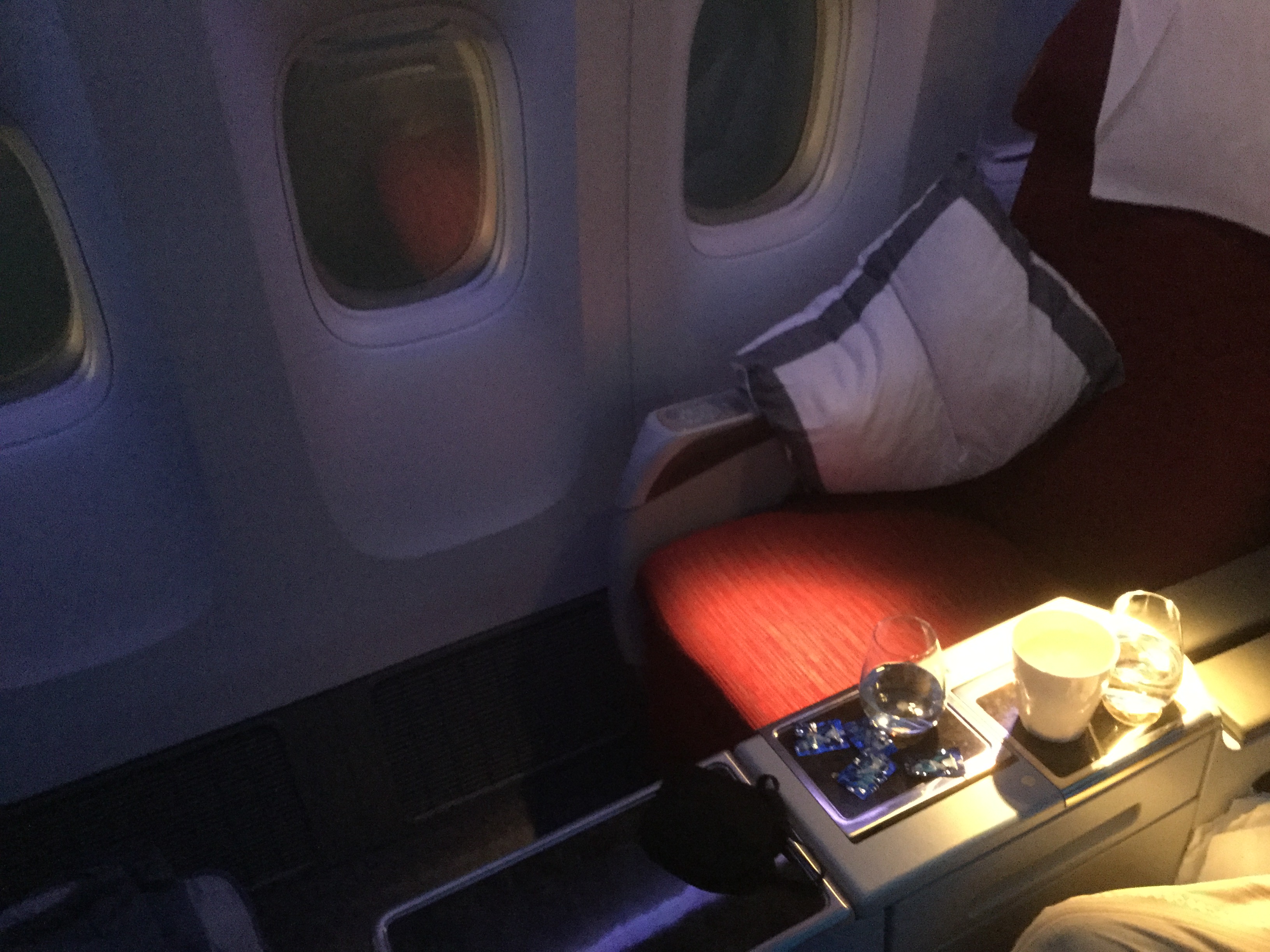
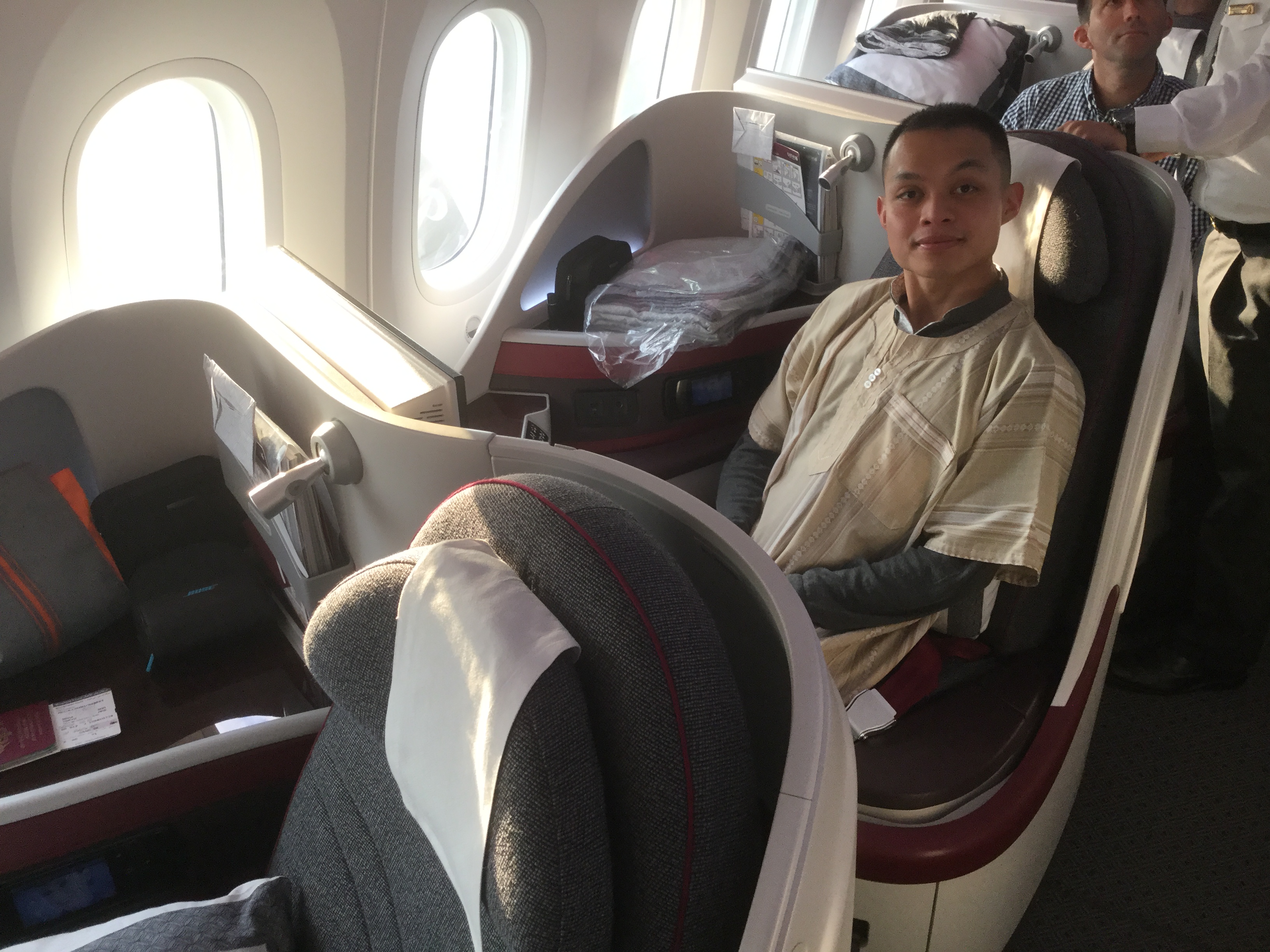
The A380s, 787s and A350s, delivered in the past five years, carry what I regard as the best business class hard product flying today. Seats are laid out in a 1-2-1 configuration, in what’s called a “reverse herringbone” which means the solo window seats are angled towards the windows. This means pax have lots of both stowage and personal living space and also privacy. Each of these three state of the art aircraft types are very quiet inside, and because they’re made with very strong composite materials, the cabin can be pressurised to around 6,000 feet in flight, versus the 8,000 ft common in all other (aluminium) airliners. The lower cabin altitude means the air can hold more oxygen, and that makes one feel better, more healthy, with better blood flow to the brain and other organs.
QR is in the long process of converting its forty-four B777s (at the rate of 1/month) to have its latest Business Class product – the QSuite, which appears to be an industry leading design that takes the business class seat to a level normally associated with first class travel, by turning each seat into a private suite with the addition of door screens. I haven’t yet flown with this product, but I am booked to do so later this year. To be honest I’m sceptical about it because to make best use of space for this design, both seats and ones personal space have been narrowed, and some seats face backwards. Also, partition screens can be lowered in the middle seats, to create a space with two seats facing each other, which QR says is good for business meetings or families flying together. I’m worried that each of those scenarios presents the possibility of noisy chatter disturbing other pax. The newest A350-1000s will be delivered with the QSuites already embodied, and after the 777s QR will retrofit its other aircraft. A press conference in Feb 18 said the A380s would be started in 2020.
Narrow-bodied A320s have lie-flat seats in the same style as the older A330s and 777s mentioned above, but in a 2-2 layout, but that’s a very good product for a single-aisled plane!
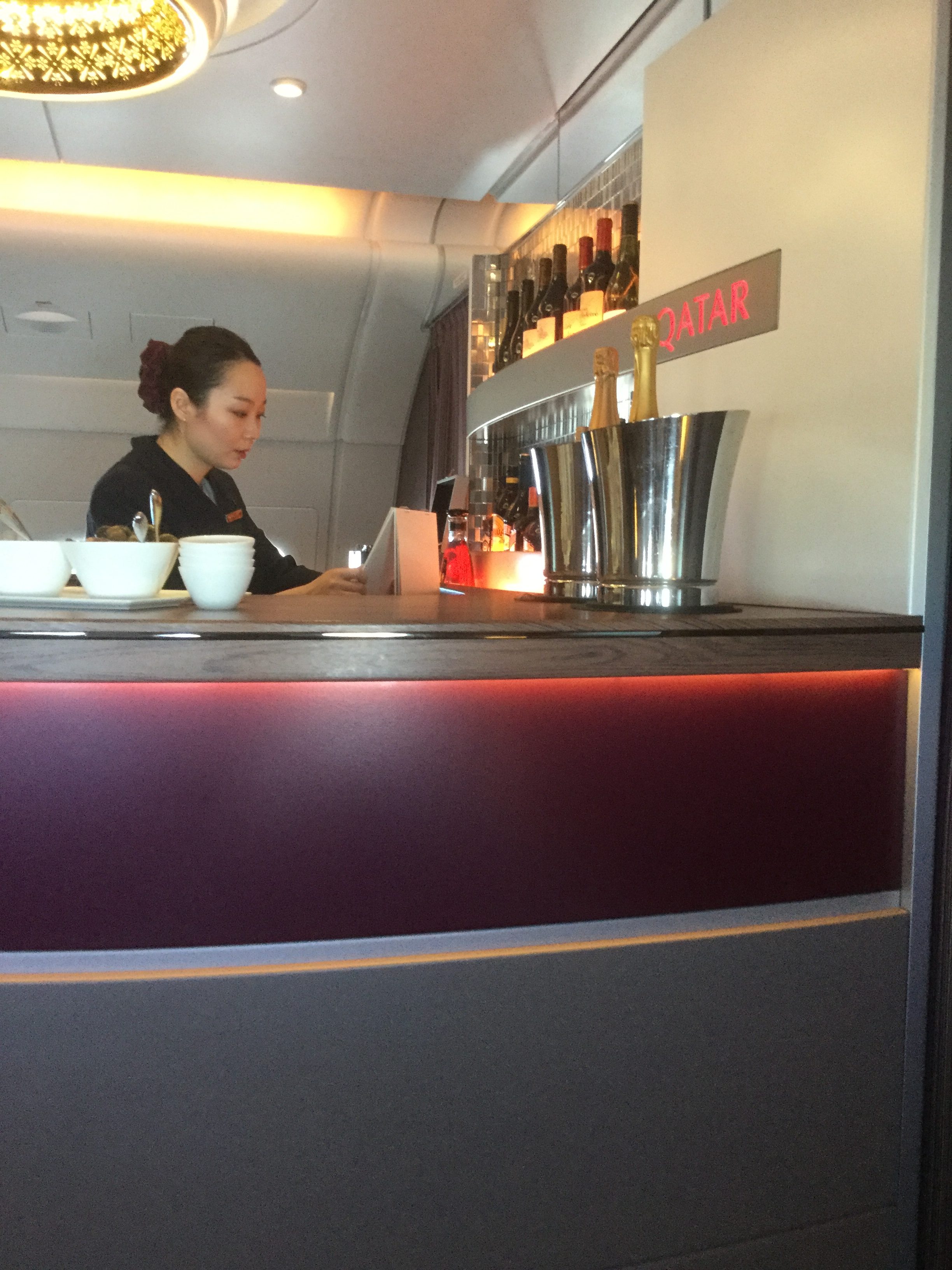
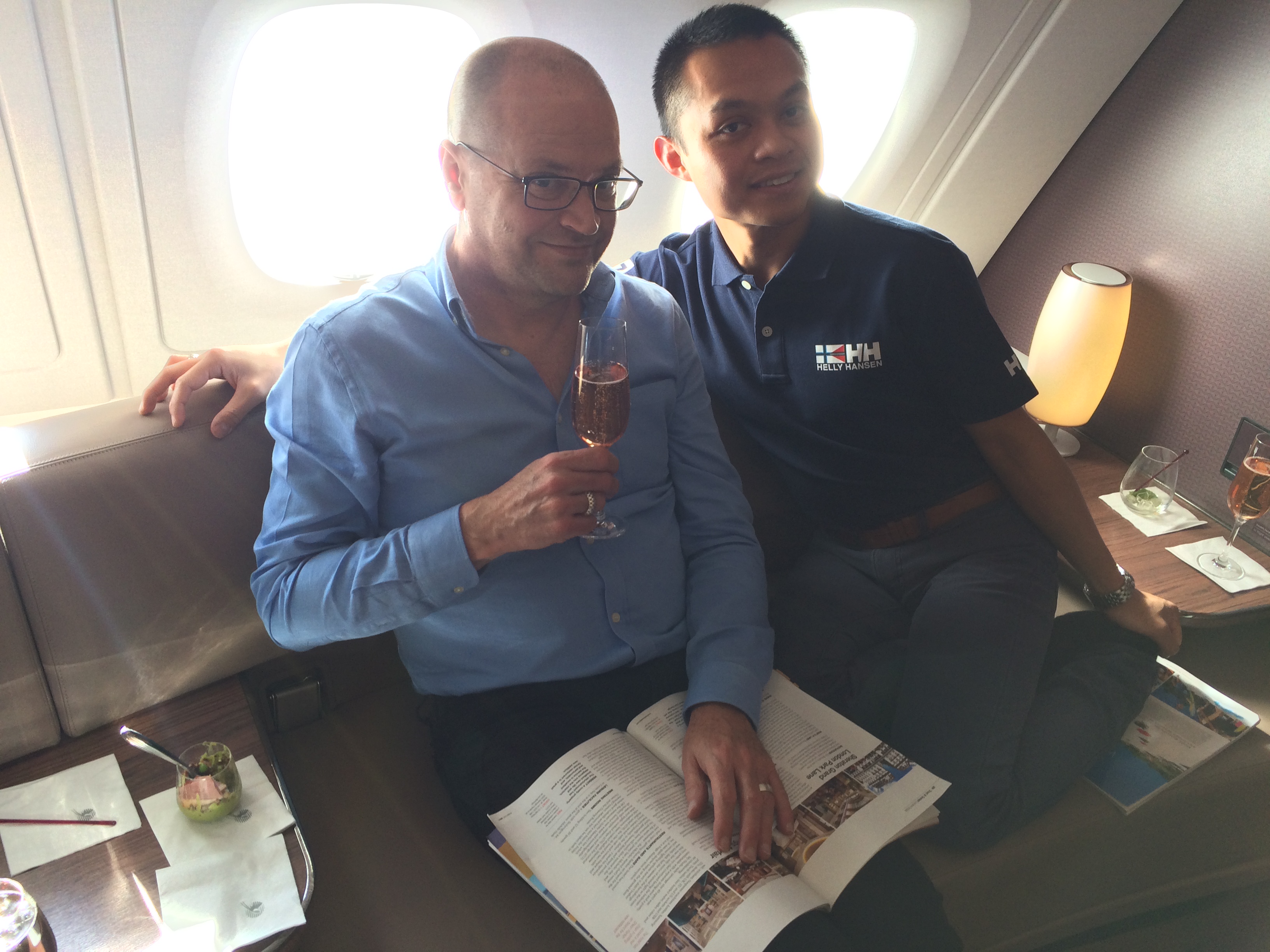
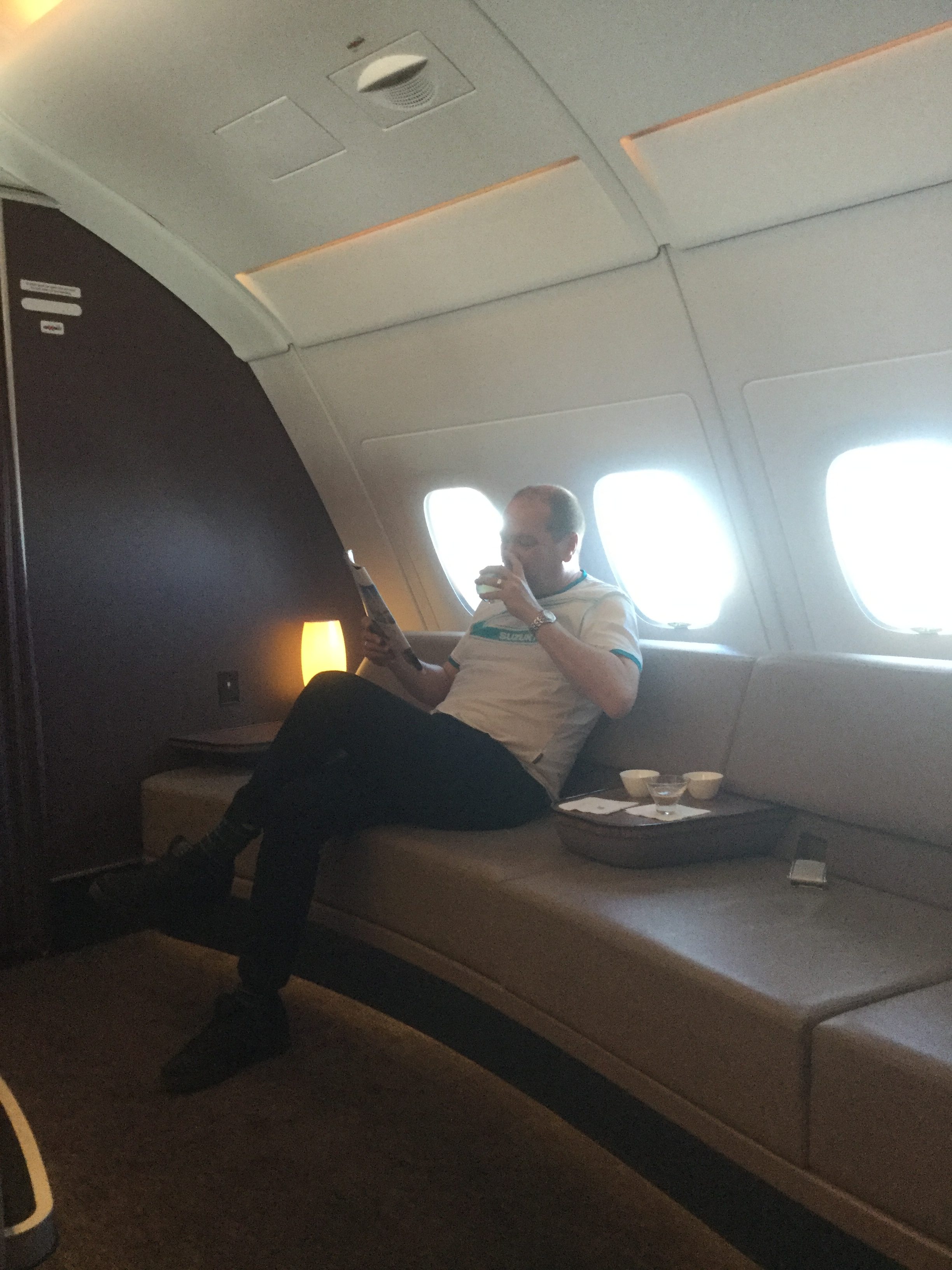
Only found on the A380s, on the upper deck behind Business Class, is what QR calls a “lounge”, but most people (especially non muslims and non-observant muslims) would call it a bar. It’s a well-designed area of soft sofas around a sweeping curve of a bar serving cocktails from a menu, other drinks, and some delicious canapés. Specially designed wall screens help to make this a most luxurious and comfortable place to stretch the legs on a long flight.
TIP – When choosing your flight, note down the aircraft type and then check it’s seat layout on SeatGuru.com , although that site’s still not showing the 777 layout with QSuites. It’s only after you’ve gone through the payment process on QR’s website, when you can select your seats, that you’ll see the cabin configuration for sure. (And that’s another positive mark for QR – BA doesn’t let business class pax select their seats in advance!)
Lounges – QR’s Premium Lounge at LHR is a super-stylish place of brightness, painted mostly white, with white sofas and chairs and floor to ceiling windows overlooking the apron at the back of Terminal 4. There are sparkling shower rooms, areas for quiet sitting, a casual dining area with buffets covering sandwiches, salads, cheeses, pastries and desserts, plus a proper sit down a la carte restaurant. And a centrepiece circular champagne bar. It’s beautiful. However I can appreciate some first class pax might feel irritated they have to share the lounge with Business pax, that they don’t have the levels of privacy and relaxation they demand.
In Doha QR’s lounges have also won several international awards, but there are different lounges for different ticket types and it might take you a while to find the one you’re able access. The largest is the Al Mourjan Business Lounge, for QR Business class pax, and wow it is big! It took me a few visits to properly explore its hidden features and the more I see of it the more I like it. But I am cautiously concerned that QR’s recent decision to allow economy pax to pay to enter the lounge will make it seem overcrowded and less of a soothing oasis.
QR also has its Al Safwa First Lounge at DOH which looks great, but I haven’t yet been inside.
Food and Drink – I’ve generally found QR’s inflight catering to be well above average. It’s fresh, well-prepared and presented, contemporary, with plenty of lighter and healthier options. One of the best meals I’ve had in the air was a seabass dish designed by Tom Aikens (one of my favourite chefs). But I should also note that I was disappointed last year to be served a cooked breakfast on their late morning departure from LHR to DOH: I’d been up for hours already and I wanted a tasty lunch! That particular menu also made a mockery of an otherwise great strength of QR’s soft product – ‘dine on demand’, when one can choose when and what to eat, from the provided menus. I didn’t see anyone choosing to have breakfast later in the flight! But broadly speaking QR does deliver on its Dine on Demand service. Later that same flight I had a very good gnocchi with blue cheese sauce, walnuts and rocket. Not all airlines offer it, or actually provide it.

The last time I flew First on British Airways, which does claim to offer dine on demand, I told the FA we would like to eat our lunch about two hours after take off, to which she replied, “actually you’ll need to have it in 30 minutes; we’ve already put all the food in the ovens”!! (and just to note, BA doesn’t offer dine on demand in Business class.)
QR’s drinks offering is good too, though it saves its vintage champagne for First Class. I noticed though that it’s possible to grab some First class wines and champagnes in the onboard lounge on the A380, which is shared between First and Business pax.
I’ll note here too that champagne and soft drinks are offered to business class pax before take-off, which isn’t the case with all airlines (see my Turkish Airlines review).
It’s also worth noting that on every QR flight I’ve been on a bottle of Evian has been in a special little compartment in my seat armrest, upon boarding, and replacements were readily available throughout the flights.
Customer Service – QR recruits from all over the world. My job experiences have taught me some it can be a real challenge getting a multi-national workforce to work well together, delivering global standards of customer service, in a warm, friendly and professional manner. QR manages this superbly, so that service levels are high and consistent across their network. Other airlines with multi-national crews don’t manage quite so well. I’m thinking of Emirates. On the odd occasion when I’ve felt the need to complain to QR about something (Asperger’s!) they have responded very well to me, and emphasised that they are constantly trying to improve all aspects of their service, in a way I found believable.
Inflight Entertainment (“IFE”) – In recent years I’ve stopped watching the IFE, apart from the ‘moving map’ feature, so I’m in no place to compare QR’s offering. I’ve become bored of the broad appeal type of films airlines show which are always censored so as not to broadcast any words which might offend anyone from anywhere in the world. I think cultural sensitivities go too far when The Lord’s Prayer is edited out of a film like The Queen.
Cons:
PRICE Mr A and I started using QR when we flew to Sri Lanka five years ago, using a 2for1 business class offer, and then a year later we took advantage of the same offer when going to Japan. BUT QR hasn’t run these offers for the past two years, and in fact their pricing is now always at the high end of price ranges when I search for fares online. I guess that when you’re regarded as the best airline in the world you don’t need to discount. Singapore Airlines follow the same practice. Now I love quality in my flying, and I’ve risen to Gold status in QR’s Privilege Club (their frequent flyer programme) through my loyalty towards QR, but I’m also pretty price sensitive, so I will share my loyalty with other airlines if I think they offer better value for money! In the past six months I’ve purchased first class tickets on other airlines at a lower price than QR was selling business class.
FLIGHT ROUTING (Doha) QR’s business model, just like that of Emirates and Etihad, has involved developing its home Gulf base into a huge transit hub which connects waves of inbound flights with waves of outbound ones, so that, with usually quite short connection times, QR can offer flights from London (for example) to myriad final destinations beyond Doha. With up to seven flights a day from LHR, and waves of connecting flights waiting, it’s easy to find convenient connections to almost anywhere on QR’s 150 city route network. Doha’s new Hamad International Airport is well suited to provide this ‘hub and spoke’ network, and its two runways operate 24/7, but the central transfer security checking area can seem terribly chaotic when it’s busy, but at least it’s not as bad as Dubai or Abu Dhabi.
Any transit through DOH is going to add time to the overall journey destination. But it does give one the chance to stretch ones legs, enjoy the lounges and maybe do some tax free shopping. If the Gulf lies naturally along the route to your long haul end destination (say Australia) then the DOH stop won’t add any time to your journey, compared with (say BA or Qantas). And I promise you an extra hour or two with QR is so much better than an hour with BA! But if you’re flying to somewhere in the Far East of the northern hemisphere, like Tokyo, DOH is quite a detour from the UK, so the direct services of BA, JAL or ANA will be significantly quicker. In fact Tokyo to LHR direct has the same flying time as Tokyo to DOH, and then you have too add on six more hours to London. You should also be aware that since the Kingdom of Saudi Arabia stopped QR overflying its territory in 2017, flights from DOH to eastern and southern Africa have to make a two hour diversion around the horn of Africa!
This Post Has 0 Comments